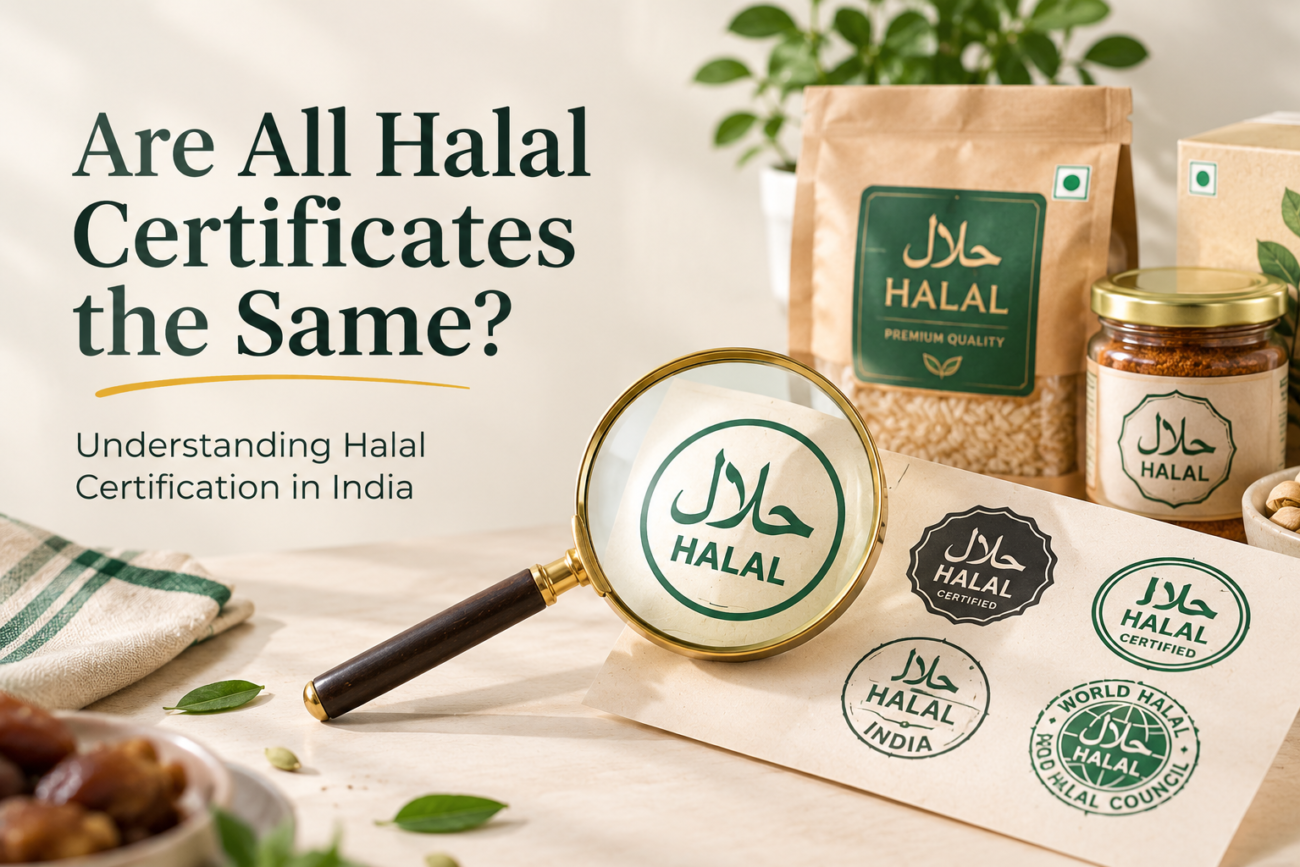
You see a Halal logo on a food packet. For many people, that logo is enough to understand that the product has some form of Halal certification.
But have you ever wondered what is actually behind that logo?
Is every Halal certificate the same? Does every Halal logo follow the same process? And does the same certification apply to every type of product?
The answer is no.
A Halal certification can vary depending on the certification body, the standard being followed, the product being certified, and the market for which the certification is meant. So, looking at the logo is only the first step. Understanding what that certification actually covers gives you a much clearer picture.
What Does Halal Certification Actually Mean?
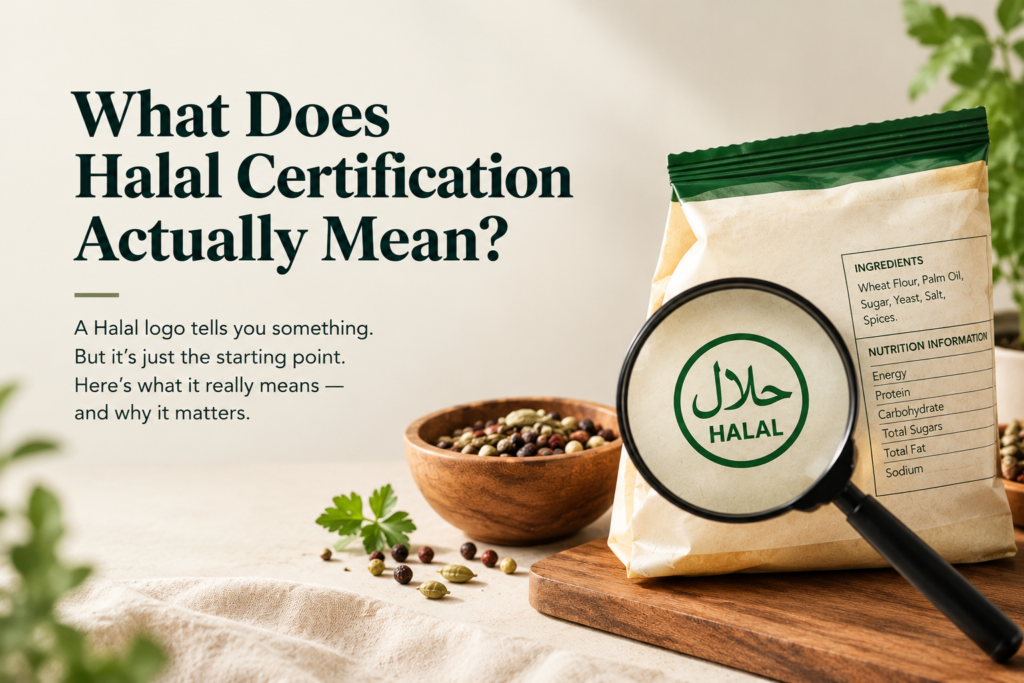
Simply put, Halal certification means that a product, process, or facility has been checked against the requirements of a particular Halal certification system.
For food, this can go beyond the ingredients listed on the packet. Depending on the certification system, things such as raw materials, production methods, handling, storage, cleaning, and segregation may also be looked at.
Think about it this way: knowing what is in a product is important, but knowing how it was made and handled can also be part of the bigger picture.
That is why two products carrying a Halal logo may not necessarily have identical certification details behind them.
Halal Certification Is Not Only About Food
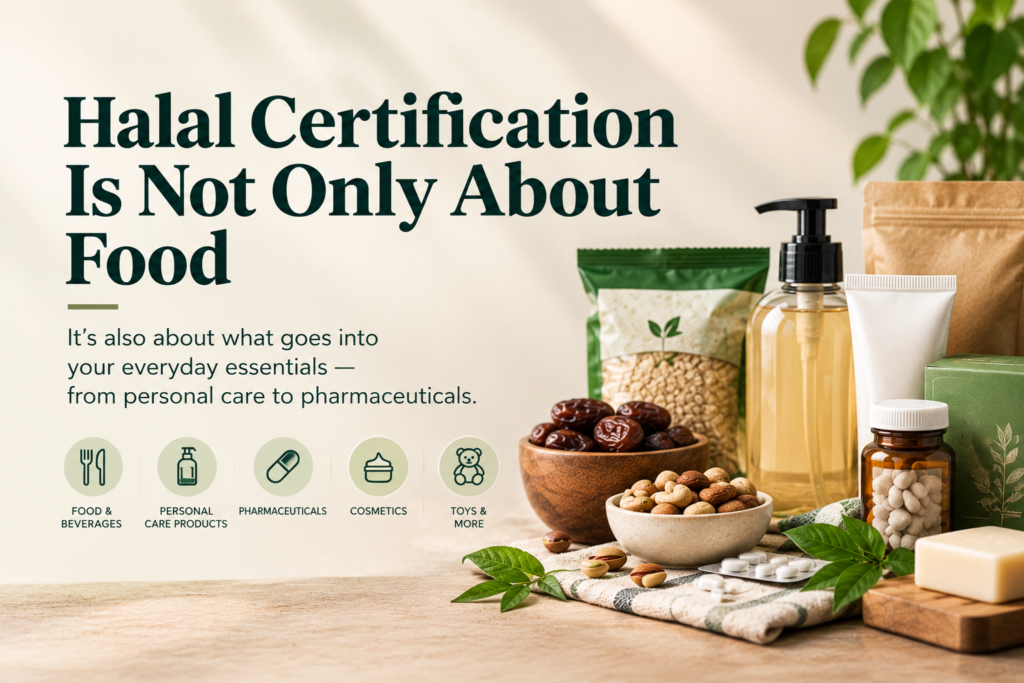
Most people immediately think of meat, packaged food, or restaurants when they hear Halal certification. But the idea can go beyond food.
Depending on the certification scheme, Halal certification may also be available for categories such as cosmetics and personal-care products, pharmaceuticals, packaging materials, chemicals, cleaning products, and certain manufacturing-related products.
But there is an important catch: one certification scheme does not automatically cover all these categories.
The product, certification body, standard, and scope all matter. So if a particular certificate covers one category, it should not automatically be assumed to cover another.
In short, seeing the word “Halal” tells you something but the details tell you more.
What Does Halal Certification Look Like in India?
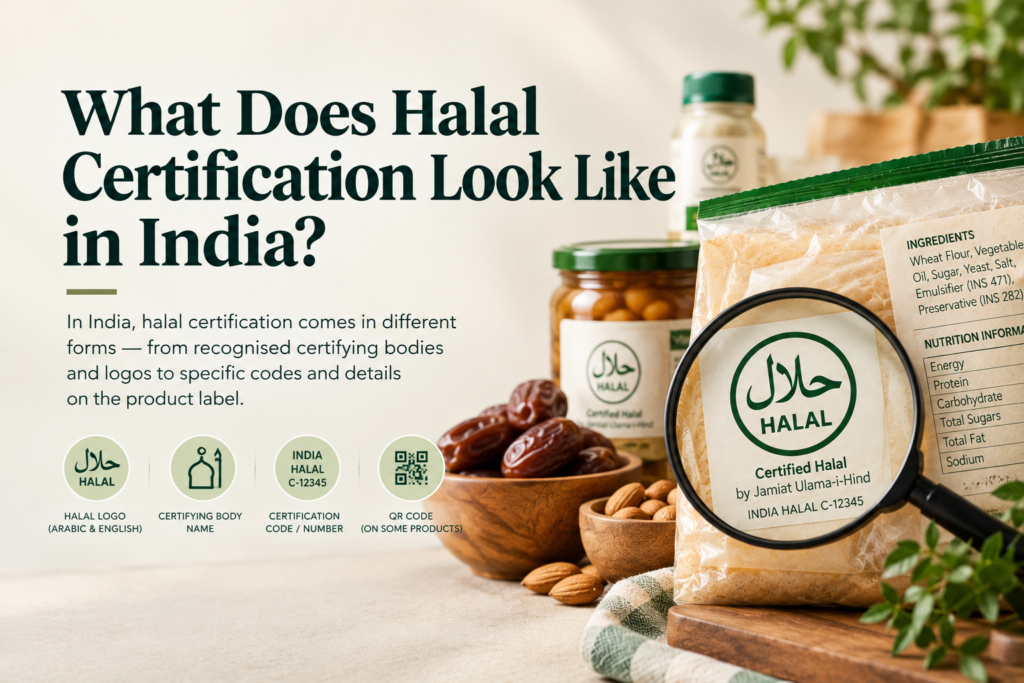
India’s Halal certification landscape has different certification bodies and certification arrangements.
One important framework is the India Conformity Assessment Scheme (i-CAS) for Halal Meat and Meat Products for Exports, established by the Quality Council of India (QCI).
The current i-CAS framework is focused on specified Halal meat and meat products meant for export. Under this framework, applicable Halal certification bodies need accreditation from the National Accreditation Board for Certification Bodies (NABCB).
There is an important point here that consumers may not always know.
In January 2026, NABCB clarified that the i-CAS Halal certification scope applies to the export of specified meat and meat products to specified countries and does not apply to India’s domestic market.
So, it would be incorrect to assume that every Halal-certified product available in India’s domestic market is certified under i-CAS.
NABCB’s listings include certification bodies such as Halal India Pvt. Ltd., Jamiat Ulama-I-Hind Halal Trust, JUHF Certification Pvt. Ltd., and IS EG Halal India Pvt. Ltd., with their accreditation linked to specific certification scopes.
This is why the details behind a certificate matter.
Why Do Companies Get Halal Certification?
There can be different reasons.
For a consumer, Halal certification can provide information about whether a product has been assessed according to a particular Halal standard.
For a company, it can also be important when selling to customers or entering markets where Halal requirements matter. In the Indian export context, for example, the i-CAS framework is connected to specified meat and meat-product exports and applicable destination markets.
But there is one thing worth clearing up.
Halal certification does not mean that a product is automatically healthier or more nutritious.
It answers a different question: whether the product meets the requirements of the relevant Halal certification system.
Nutrition, ingredients, and certification each tell you something different about a product.
So, Are All Halal Certificates the Same?
No.
Imagine two products sitting next to each other on a shelf. Both have a Halal logo, but that does not necessarily mean their certificates were issued by the same body, follow the same scheme, or cover exactly the same things.
If Halal certification is important to your food choice, a few simple details are worth checking:
Who issued the certificate? What product does it cover? Which certification scheme was used? Is it still valid? And what market or geographical area does it apply to?
You do not need to understand every technical detail.
The basic idea is simple: don’t look at only the logo; look at what is behind it.
How Can Poorna Satya Help?
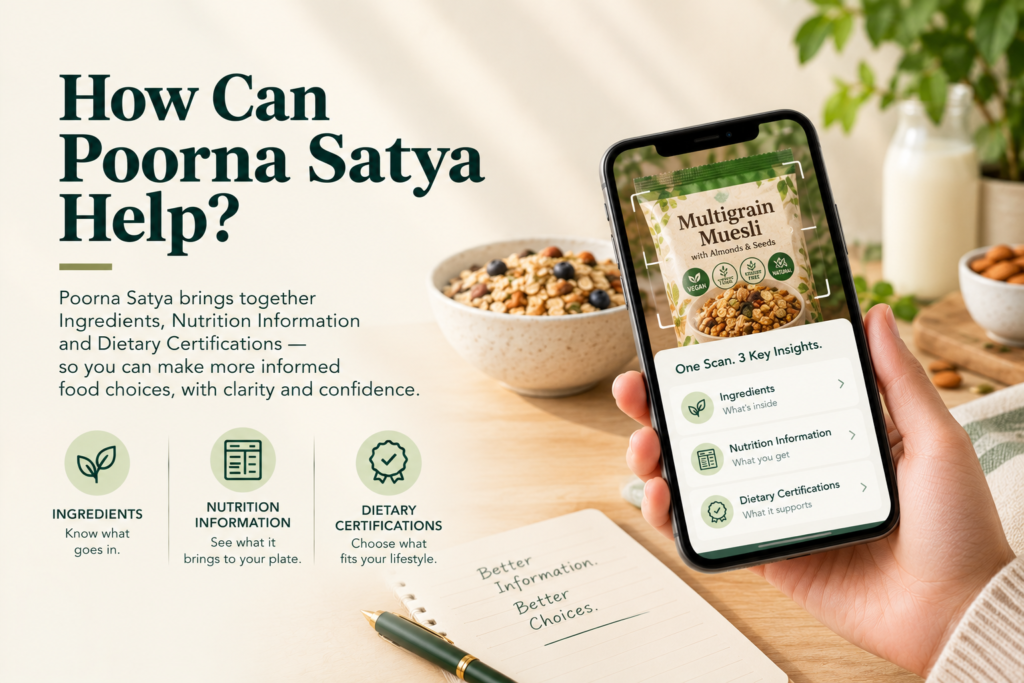
This is where food transparency becomes useful.
When buying packaged food, there is already a lot to look at. There is the ingredient list, nutrition panel, claims, symbols, and dietary certifications. Sometimes finding the information you actually care about can feel like putting together a small puzzle.
Poorna Satya is designed to make that easier.
When relevant Halal certification information is available for a product in its database, Poorna Satya helps consumers see that certification along with the product’s Ingredients and Nutrition Information.
So instead of looking at a certification symbol separately, consumers can get a broader view of the product.
With one scan, Poorna Satya brings together:
Ingredients + Nutrition Information + Dietary Certifications
And importantly, Poorna Satya does not issue Halal certificates. It does not decide whether a product should be considered Halal. Its role is to help make the available product information easier to find and understand.
Final Thought
A Halal logo may be small, but there can be quite a bit of information behind it.
The certification body, the standard, the product covered, the validity, and the market for which it applies can all make a difference.
India’s i-CAS framework is a good example of why this context matters. Its current scope is focused on specified Halal meat and meat products for export and does not apply to India’s domestic market.
So, instead of simply asking:
“Is this product Halal certified?”
it may be more useful to ask:
“Who certified it, under which system, and what exactly does the certification cover?”
India’s First App to Align Food with Belief.
We believe in empowering individuals to make choices that align with their unique lifestyles.Because a logo can give you a quick signal, but the information behind it gives you context.
And food transparency is ultimately about that- making information easier to understand without telling people what they should choose.
The choice stays with you.
Poorna Satya- Know What You Eat.
for more much content do follow:https://poornasatya.com/
