Pick up a packaged food product in a supermarket and you’ll probably notice several statements on the front of the pack.
“No Added Sugar.”
“High Protein.”
“100% Veg.”
“Natural.”
These statements can be helpful. They give you a quick idea of what the brand wants you to notice about the product.
But there is usually more information waiting on the rest of the packet.
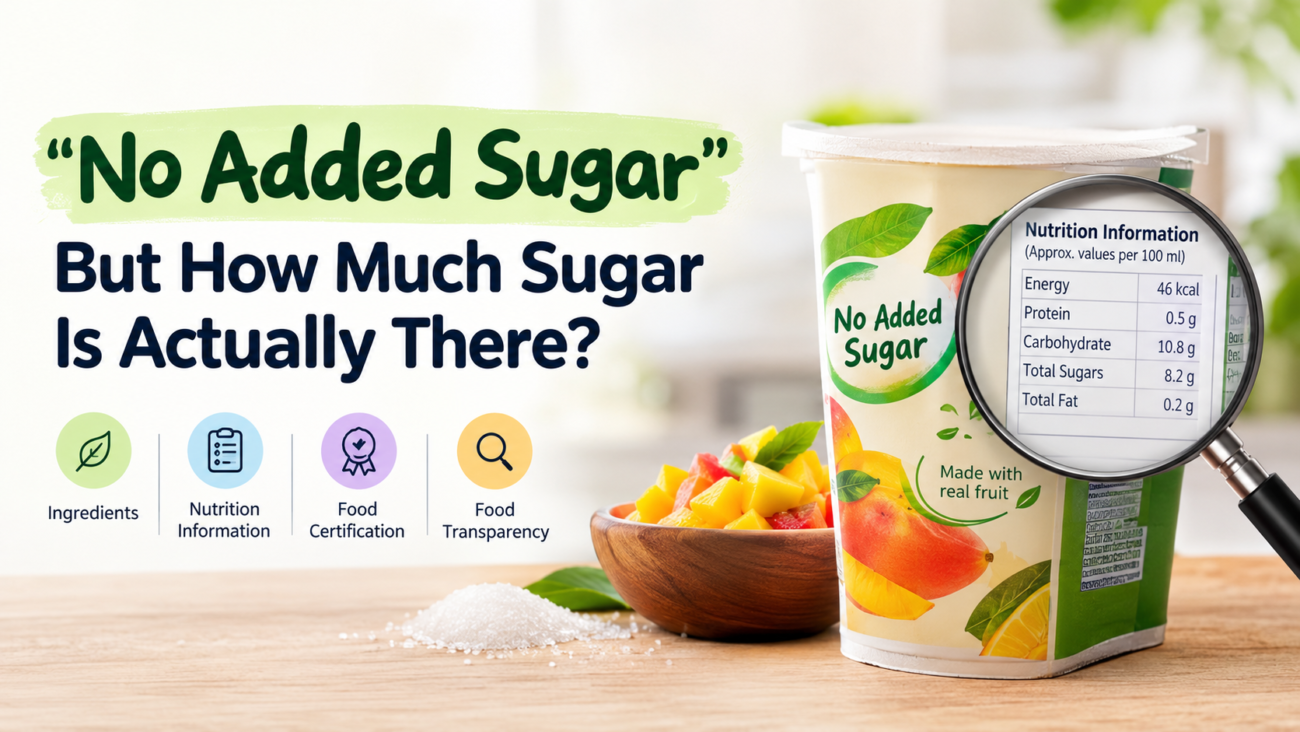
Take “No Added Sugar”, for example.
Seeing those words may make you think the product contains very little sugar. But that’s not necessarily the case. A product can have no added sugar and still contain naturally occurring sugar from ingredients such as fruit or milk.
This is where reading the rest of the label becomes useful.
The Nutrition Information can tell you how much sugar the product contains. The ingredients list can help you understand what has gone into making it. And if a particular dietary certification matters to you, that is another piece of information worth checking.
You don’t need to become a nutrition expert to understand all of this.
You just need to know what each part of the label is actually telling you.
Where Sugar Can Come From in a “No Added Sugar” Product
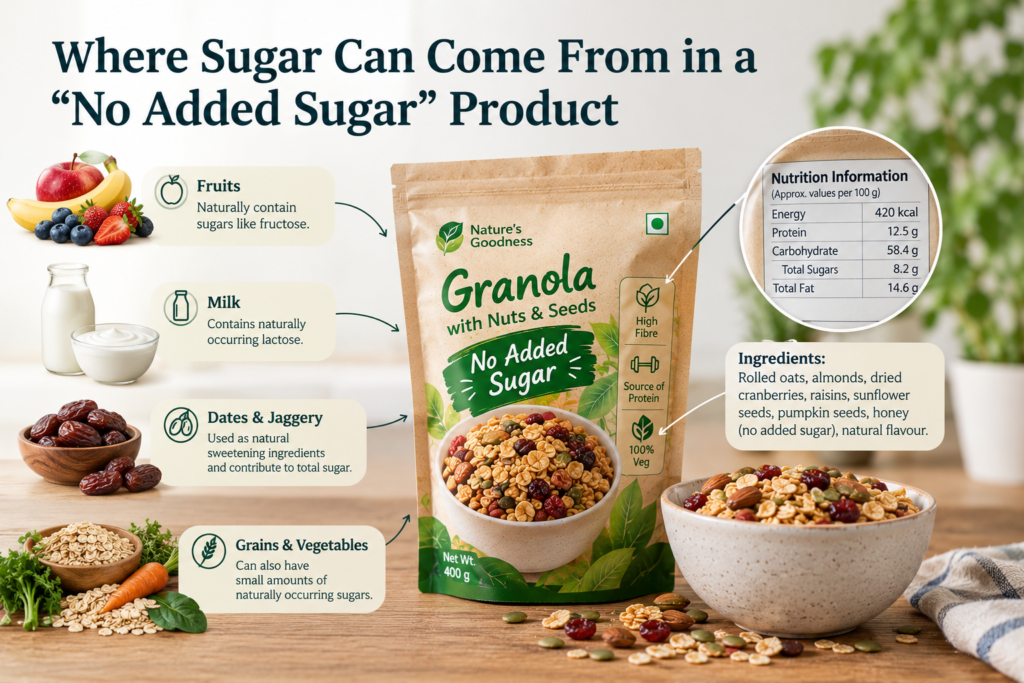
Seeing “No Added Sugar” on a packet means that additional sugar has not been added during the preparation of the product. However, it does not necessarily mean that the product contains no sugar.
Many ingredients naturally contain sugar. Fruits contain naturally occurring sugars, while milk contains lactose. Dates and other naturally sweet ingredients can also contribute to the total sugar in a product.
For example, a fruit drink may contain sugar from the fruit itself, even when no extra sugar has been added. Similarly, a snack made with dates may not contain added table sugar, but the dates can still contribute to its total sugar content.
This is where the ingredients list and Nutrition Information become useful. The ingredients list helps you understand what has been used in the product, while the Nutrition Information shows how much total sugar and other nutrients it contains.
It’s also important to consider the serving size. If the nutritional values are given for one serving but you consume two, the amount you consume will be higher than the value shown for a single serving.
So, when you see “No Added Sugar,” don’t look at the claim alone. Check the ingredients, total sugar and serving size together to get a clearer picture of the product.
Ingredients and Nutrition Information Tell You Different Things
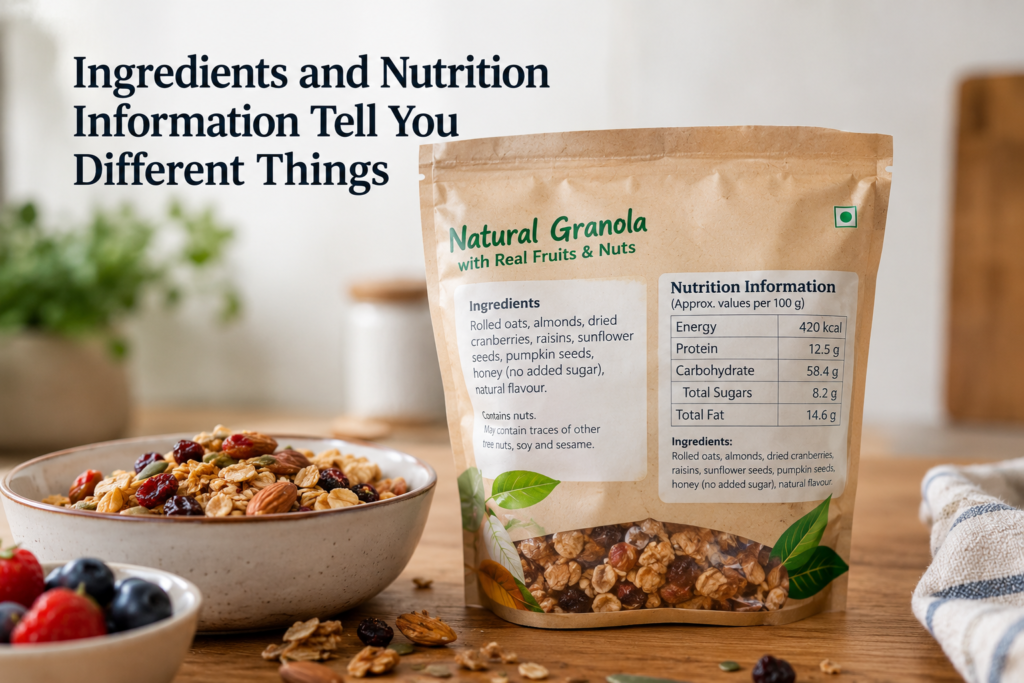
The ingredients list and Nutrition Information may appear next to each other, but they tell you different things about a product.
The ingredients list shows what has been used to make the product, while Nutrition Information tells you about its nutritional composition, such as energy, protein, carbohydrates and fat.
For example, when comparing two breakfast products, the ingredients can help you see what’s inside each one, while the Nutrition Information helps you compare their nutritional values.
Then there is food certification, which relates to specific standards or requirements that a product may meet.
Looking at these details together gives you a clearer understanding of the product instead of relying only on what is highlighted on the front of the packet.
A Product Claim and a Food Certification Are Not the Same Thing
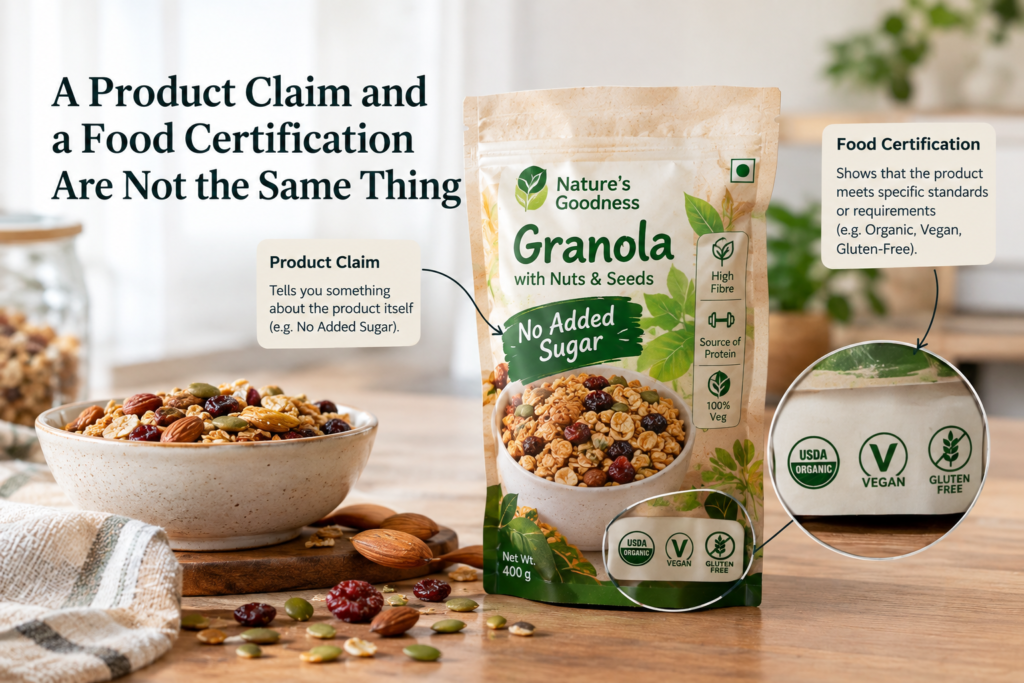
There is another distinction worth understanding when you’re reading packaged food labels.
A product claim and a food certification serve different purposes.
Take “No Added Sugar.”
It tells you something specific about the product’s sugar formulation.
Now consider a statement such as “High Protein.”
That highlights a nutritional characteristic.
Or consider “100% Veg.”
That gives you information about the vegetarian nature of the product.
A food certification, however, is connected to a particular certification system and its requirements.
Depending on the certification, those requirements can relate to ingredients, production, handling, sourcing or other defined aspects of the product.
So if you’re looking for a specific dietary certification, a claim such as “No Added Sugar” or “100% Veg” does not automatically answer that question.
These statements can all be useful, but they are providing different kinds of information.
How Poorna Satya Can Help
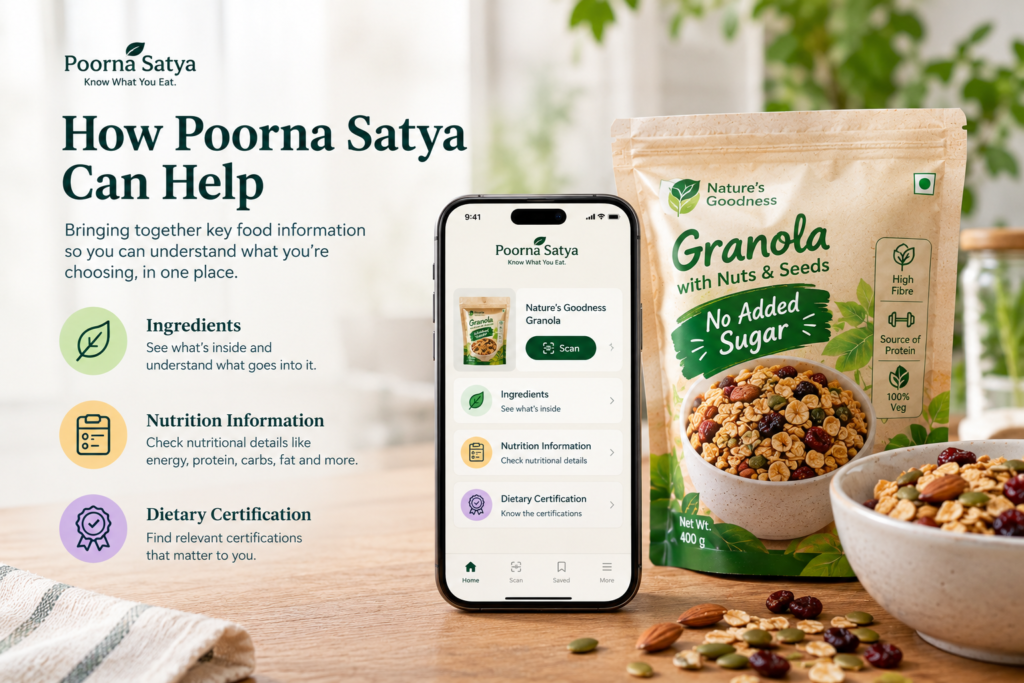
This is where Poorna Satya takes a broader approach to food information.
Poorna Satya is a Food Transparency and Food Awareness Platform created to make packaged food information easier to understand.
When you’re looking at a product, you may want answers to several different questions.
What ingredients are in it?
What does the Nutrition Information tell you?
Does it have a dietary certification that is relevant to you?
Instead of checking these details separately, Poorna Satya brings three important areas of product information together:
Ingredients
You can explore the ingredients used in the product and understand what goes into it.
Nutrition Information
You can check nutritional details such as sugar, carbohydrates, protein and other available nutritional information.
Dietary Certification
You can check relevant certification information associated with the product.
This can be especially useful when a product has a claim such as “No Added Sugar.”
The claim may catch your attention, but you may still want to understand the ingredients, check the nutritional information and see whether the product carries a relevant dietary certification.
With a single scan, Poorna Satya is designed to bring these three areas of information together, where the relevant product data is available.
The purpose is not to tell you which product you should buy.
It is about making the information easier to access so you can make your own choice based on what matters to you..
Why Food Transparency Matters
Food choices are personal.
For one person, sugar may be the most important thing to check.
For someone else, ingredients may matter more.
Another person may specifically want to know whether a product carries a particular dietary certification.
There isn’t one piece of information that answers all of these questions.
That’s why food transparency matters.
It gives you the opportunity to look beyond a single statement on the packet and understand different aspects of the product before making your choice.
“No Added Sugar” has its place.
So do the ingredients, Nutrition Information and dietary certification.
The more clearly you understand what each one tells you, the easier it becomes to make sense of the product in front of you.
Conclusion
“No Added Sugar” can be useful information, but it is only one part of understanding a packaged food product.
The total sugar, serving size, ingredients, nutritional values and relevant dietary certifications can all tell you something different.
The same applies to claims such as “High Protein” or “100% Veg.” They can help you understand a particular characteristic of a product, but they don’t necessarily answer every question you may have.
This is the thinking behind Poorna Satya.
By bringing Ingredients, Nutrition Information and Dietary Certification together, Poorna Satya makes it easier to explore the information behind the packaging before making your choice.
Because understanding your food isn’t about reading every single word on a packet.
It’s about knowing which information matters and being able to understand it.
Poorna Satya- Know What You Eat.
for more much content do follow : https://poornasatya.com/
